


Expert DJ Services for Major Events
DJ Graffiti offers expert corporate event DJ services nationwide, specializing in tailored entertainment and live event production that align music, pacing, and audiovisual design with business objectives. While serving clients across the country, we maintain a strong focus on Toledo, OH, where our local expertise plays a pivotal role when events take place in convention centers and major venues. This article explains how professional corporate DJs design reliable, brand-appropriate entertainment for large-scale conference environments, why venue familiarity matters for logistics and attendee experience (especially in Toledo), and how sound and lighting choices affect engagement and clarity. Event planners will learn what to ask when hiring a DJ for both local and national events, the step-by-step booking workflow for convention-center events, the latest trends shaping 2025 corporate entertainment (including hybrid production and advanced audio tech), and practical technical requirements to include in contracts and rider documents. Throughout, the guidance highlights semantic distinctions—hyponyms such as award-ceremony DJs and trade-show DJ services, meronyms like sound system and lighting rig, and hypernyms such as event entertainment and professional DJ services—to help planners identify the precise service needed. Practical lists, comparison tables, and booking checklists make this a hands-on reference for planners sourcing a conference DJ in Toledo convention centers and major venues, or for events anywhere in the U.S.
What Makes DJ Graffiti the Top Choice for Corporate Event DJ Services, Nationally and in Toledo?
A top corporate event DJ combines consultative planning, venue-specific logistics knowledge, and production-grade equipment to deliver predictable results that support event objectives, whether in Toledo or across the nation. This combination works because a consultative process maps music and MC roles to the event agenda, while venue familiarity (or thorough pre-event research for out-of-state venues) reduces setup friction and technical conflicts with house AV systems, producing a seamless attendee experience. Professional DJs act as both entertainment and production partners, coordinating with corporate AV teams and event production companies to ensure transitions, keynote timing, and networking music all reinforce the agenda. The result is higher audience engagement, fewer last-minute audio issues, and an event flow that reflects brand tone and priorities. Below is a concise list of differentiators that planners should evaluate when choosing a corporate DJ for convention centers and major venues, applicable to both local Toledo events and nationwide engagements.
DJ Graffiti’s core differentiators are underscored by a consultative approach and extensive venue experience that help planners avoid common pitfalls and keep events on schedule, regardless of location:
- Consultative Planning: A formal planning call and run-of-show alignment reduce ambiguity and specify MC/announcement responsibilities for any event, anywhere.
- Venue Expertise & Research: Familiarity with major Toledo venues, combined with thorough pre-event research for national locations, shortens load-in time and improves compatibility with in-house AV.
- Production-Grade Gear: Use of professional sound and lighting rigs ensures consistent coverage and stage presence, with options for local rentals or shipping for national events.
- Music Customization: Curated playlists and live mixing that align with session tone, audience demographics, and brand identity, tailored for diverse audiences.
- Reliability Practices: Redundancy in playback and microphone systems plus clear technical riders to prevent interruptions, a critical factor for high-stakes events.
These differentiators point directly to the practical steps planners should request when vetting vendors, which leads naturally into how music is customized for corporate occasions and what equipment underpins reliable production.
How Does DJ Graffiti Customize Music for Business Events?

Customizing music for corporate events begins with a focused consultation that identifies audience profile, event goals, and the role music plays at each agenda point. The mechanism is simple: map musical energy and genre to agenda moments—ambient instrumental sets for networking, neutral pop for breaks, and higher-energy mixes for receptions—so that music supports behavior rather than distracts from content. Pre-event playlist creation and live-adaptation protocols let the DJ pivot in real time based on crowd energy and speaker timing, and playlists can be aligned with corporate brand guidelines to avoid inappropriate lyrics or tone. Planners should prepare a short music brief that lists preferred genres, banned songs, and examples of desired atmosphere to streamline curation. This process yields a music program that reinforces messaging and creates natural transitions between keynote, breakout, and social segments, consistently applied whether the event is in Toledo or a national convention center.
What Professional Sound and Lighting Equipment Does DJ Graffiti Use?
Professional event sound and lighting comprise multiple components that work together to deliver clarity, coverage, and mood in large halls and ballrooms, essential for both local and national events. The key equipment categories include high-coverage speaker systems for even SPL (sound pressure level) across seating, digital mixers with scene recall for rapid configuration across agenda segments, wireless microphones and line-level interfaces for speaker integration, and lighting rigs (uplights and moving-head fixtures) to define stage presence and branded ambience. Redundancy practices—secondary playback devices, spare microphones, and backup power distribution—mitigate risk during live sessions and are standard for convention-center deployments. For national events, DJ Graffiti can travel with core equipment or coordinate local, high-quality rentals to ensure seamless production. Below is a comparison table highlighting equipment categories, attributes, and venue suitability.
Introductory table: How core AV components compare for convention-center use.
This equipment mix provides a production backbone that supports both speech-heavy sessions and music-driven receptions, and coordination with venue AV teams ensures compatibility with house systems and rigging constraints, whether in Toledo or a major city nationwide.
How to Book a Professional DJ for Corporate Events at Toledo Convention Centers or Nationwide?
Booking a professional DJ for a convention-center event, whether local or national, requires clear timelines, defined responsibilities, and contractual terms that protect both planner and vendor. The process works best when planners allow adequate lead time to confirm venue insurance requirements, AV load-in windows, and run-of-show integration with house technicians. For national events, additional considerations include travel logistics, equipment shipping, and potential local crew coordination. Essential information to collect before outreach includes expected attendance, room configurations, scheduled set times, and the venue’s technical contact. Contracts should outline deposit, cancellation policies, set times, overtime rates, technical rider requirements, and any applicable travel or per diem costs. On-site coordination—typically via a planning call and a pre-event site visit or virtual walk-through—aligns the DJ, venue technicians, and event producers around cueing and mic handoffs.
The step-by-step booking workflow below is snippet-friendly and guides planners from inquiry to post-event follow-up for both Toledo and nationwide events:
- Initial Inquiry & Availability Check: Provide event date, venue, estimated attendance, and basic agenda to confirm availability and discuss travel logistics for national events.
- Proposal & Contract: Receive a written proposal that lists included services, deposit amount, contract terms, and any travel/lodging specifics to secure the date.
- Planning Calls & Logistics: Schedule planning calls to align run-of-show, MC roles, music brief, and technical rider details, including coordination with venue AV and any local production teams.
- Site Visit / Tech Walk: Coordinate a site visit or virtual tour with venue AV to verify power, rigging, and staging needs, especially crucial for unfamiliar national venues.
- Day-Of Execution: Confirm load-in time, soundcheck, and run-of-show cues with the venue’s technical staff and event production team.
- Post-Event Follow-Up: Debrief on performance, logistics, and any follow-up items needed for billing or future events.
This workflow reduces ambiguity and clarifies responsibilities, creating predictable outcomes for complex convention-center productions, whether in Toledo or across the country. For planners ready to move forward, DJ Graffiti offers a consultative booking approach to confirm availability and develop a tailored entertainment plan.
What Is the Step-by-Step Booking Process for Corporate Event DJs?
The concise booking steps below focus on the operational details planners must manage to secure a corporate DJ and ensure smooth day-of production, for both local and national events. Begin by compiling event basics—date, venue, expected headcount, and agenda—so vendors can provide accurate proposals that reflect room size, technical needs, and travel considerations. After proposal acceptance, a signed contract and deposit hold the date while planning calls define the run-of-show and music brief; these calls should include the venue’s AV contact to reconcile technical riders. For national events, discuss equipment logistics (shipping vs. local rental) and travel arrangements. A site visit or virtual walk will confirm load-in paths, power availability, and stage footprint, and final playlists or program cues are submitted in advance for review. On event day, confirm the DJ’s arrival window, soundcheck schedule, and point of contact for cueing, then conduct a short post-event debrief to capture lessons learned.
Which Packages and Pricing Options Are Available for Business Event DJ Services?
Planners should evaluate packages by inclusion rather than headline price, since hours, MC services, lighting, and travel affect total cost for convention-center events, especially those requiring nationwide travel. Typical package tiers range from essentials-focused coverage for breakout-level sessions to full-production offerings that include uplighting, on-stage mixing, and an MC for award ceremonies. Custom add-ons such as extended hours, branded lighting schemes, additional microphones, and travel/lodging expenses are available to tailor the package to event scale and objectives. The table below summarizes common package types and which event situations they best serve.
Package comparison table: High-level inclusions to guide selection.
Selecting the right package depends on room size, whether the DJ must integrate with house sound, the desired production level, and the event location; planners should provide venue specs and agenda to receive an accurate, customized quote that includes all travel and logistics for national events.
What Are the Latest Trends in Corporate Event Entertainment for Toledo Venues and Beyond in 2025?
Corporate event entertainment in 2025 emphasizes hybrid engagement, immersive audio, and data-driven interaction to maximize reach and measure impact, trends that DJ Graffiti implements for events in Toledo and nationwide. Hybrid events require DJs and production teams to balance in-room audio for live attendees with livestream feeds for remote viewers, and this dual focus elevates requirements for audio routing, mix-minus setups, and coordination with streaming platforms. Immersive lighting and staged entertainment create memorable brand moments in large halls, while spatial audio and advanced speaker arrays improve speech intelligibility in wide, column-free exhibit spaces. Event planners now expect production partners to provide measurable engagement indicators—such as pacing effects and audience energy observations—that inform post-event ROI discussions. These trends push planners to prioritize vendors who can operate seamlessly across live and virtual environments and who bring technical knowledge of contemporary audio and lighting technologies.
Key 2025 trends planners should consider for Toledo convention centers and national venues:
- Hybrid-Ready Production: DJs and AV teams coordinate audio for both live and streamed audiences, ensuring a cohesive experience.
- Immersive Lighting & Staging: Branded, programmable lighting enhances key moments and photography, creating impactful visual experiences.
- Advanced Coverage: Line-array and digital mixers provide consistent audio in large halls, critical for clarity in expansive spaces.
- Engagement Analytics: Production choices tied to measurable attendee interaction and dwell-time, informing future event strategies.
This evolution toward hybrid and immersive formats also demands practical coordination on the technical side, which we outline in the next subsection.
How Are Hybrid Events Changing Corporate DJ Entertainment?
Hybrid events require DJs to serve as both in-room entertainers and virtual audio partners, which changes equipment, routing, and cueing practices for events in Toledo and across the country. DJs must plan audio feeds that separate room reinforcement from streamed mixes, use digital mixers with multitrack outputs, and coordinate with livestream producers to ensure speech intelligibility and music balance for remote attendees. Technical checks should include latency tests, backup streams, and redundant internet or audio-over-IP paths where applicable; these measures reduce the risk of dropouts that harm both live and virtual experiences. In practice, DJs adapt playlist pacing to accommodate camera cues and remote Q&A windows, and they work closely with the AV team to maintain consistent levels when presenters move between podiums and open-floor Q&A. Hybrid competence translates into fewer streaming interruptions and a more unified attendee experience across platforms.
What Advanced Sound Technologies Enhance Corporate Event Experiences?
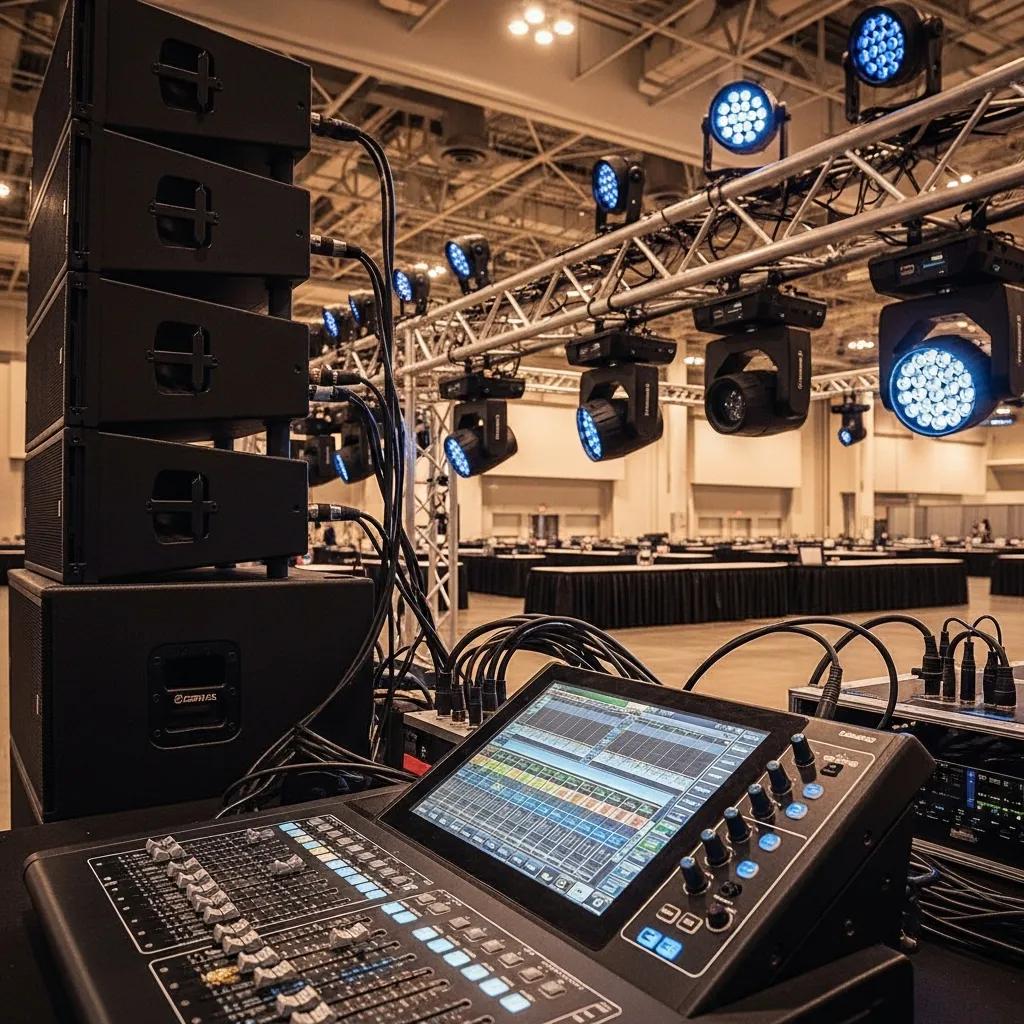
Advanced sound technologies such as digital mixers with scene recall, line-array speakers for even coverage, wireless in-ear monitoring, and spatial audio processing improve clarity and adaptability in convention-center environments, whether in Toledo or a major city. Digital mixers allow production teams to store presets for keynote, panel, and reception modes, enabling swift transitions without extended manual mixing. Line-array systems deliver consistent SPL across long throw distances while minimizing reflections, which increases speech intelligibility and music fidelity in exhibit halls. Spatial audio and multichannel solutions can create immersive zones for networking areas without impacting speech areas, and wireless microphone systems with managed frequency plans reduce interference in RF-congested venues. Choosing the right technology for the room directly affects attendee comprehension, perceived production value, and overall event impact.
What Do Event Planners and Executives Say About DJ Graffiti’s Corporate Event Services?
Event planners and corporate executives consistently evaluate vendors based on reliability, production coordination, and the ability to reinforce event objectives through music and MC functions. DJ Graffiti’s social proof often centers on on-time execution, clarity of communication during planning, and the capacity to adapt music programming to brand guidelines, demonstrated in both Toledo and national events. Planners should request case studies that describe challenge, solution, and outcome, and they should verify references with events similar in scale and venue type. While many providers highlight testimonials, the most useful evidence comes from structured case snapshots that explain how a DJ integrated with venue AV, supported speaker timing, and contributed to attendee engagement metrics.
Below is a compact table summarizing illustrative case-study snapshots that planners can use to evaluate fit; these are qualitative summaries intended to show typical problem-solution-outcome patterns rather than exhaustive records, reflecting DJ Graffiti’s diverse experience.
Case study snapshots table: Typical event objectives, solutions, and outcomes.
These structured snapshots help planners see how production choices translate into outcomes, and they provide a framework for vetting potential DJs for similar events, whether in Toledo or across the country.
Which Case Studies Highlight Successful Corporate Events at Toledo Convention Centers and Nationally?
DJ Graffiti’s case studies typically follow a problem → production solution → outcome model that clarifies the DJ’s role in meeting objectives, showcasing expertise in Toledo and beyond. One common pattern shows a client needing discreet music during networking and a more animated mix for an evening reception; the production solution pairs playlist segmentation with live mixing pads to protect keynote audio. Another pattern involves complex speaker rotations and award transitions, where scene recall and precise cueing prevent delays and keep the schedule on track, often involving coordination with diverse venue teams across different states. Outcomes most valued by planners include minimal technical issues, on-time program delivery, and music that supports rather than competes with event messaging. Planners should request similar case study narratives when evaluating vendors so they can assess how a DJ’s processes map to event requirements, including those with nationwide travel.
What Client Testimonials Demonstrate DJ Graffiti’s Expertise?
DJ Graffiti’s client testimonials consistently reference specific attributes such as responsiveness during planning, smooth integration with venue AV (both local and national), and effectiveness at managing energy during receptions. Useful testimonial indicators include mentions of whether the vendor followed a technical rider, how well MC duties were handled, and whether there were measurable improvements in attendee flow or atmosphere. Planners can corroborate these claims by requesting references from comparable events and by reviewing case-study media assets where available. For those seeking further assurance, DJ Graffiti’s online presence includes structured case studies and client feedback that demonstrate logistics strengths and event-focused music curation for a wide range of events.
What Are the Most Common FAQs About Corporate Event DJ Services in Toledo and Nationwide?
Event planners frequently ask about setup timing, technical riders, power and space needs, pricing influences, and insurance or permit requirements for convention-center work, especially when considering nationwide travel. These questions are practical because large venues have strict load-in schedules, power distribution standards, and stage footprint rules that affect both cost and feasibility. DJs should provide a concise technical rider that lists stage dimensions, power requirements, preferred load-in windows, and AV contact details; this rider forms the basis of coordination with venue technicians. Pricing typically depends on hours of service, production level, travel, equipment shipping, and any venue-specific integration needs, while deposits and cancellation terms should be explicitly spelled out in contracts. Below are direct Q&A pairs formatted for quick reference.
- How long does setup and soundcheck typically take? Setup and soundcheck time varies by scale but generally requires one to three hours for line-array systems in ballrooms, including time for coordination with venue FOH.
- What technical documentation should planners request? Planners should request a technical rider listing power needs, stage footprint, mic and DI requirements, and preferred load-in routes.
- Do DJs provide redundancy for critical systems? Professional DJs include redundancy such as backup playback devices and spare microphones to minimize the risk of failure during key moments.
- How do venue rules affect pricing? Venue regulations on load-in windows, union labor, and rigging access can influence required staffing and timeline, which affect total cost.
- What insurance or permits are typically required? Most convention centers require vendor proof of insurance and may have specific venue permit requirements; planners should confirm those early in the contract stage.
- Does DJ Graffiti travel nationwide for corporate events? Yes, DJ Graffiti provides corporate event DJ services across the United States, with extensive experience in managing logistics for out-of-state engagements.
- What are the travel costs for out-of-state events? Travel costs typically include flights, accommodation, per diem, and potentially equipment shipping or local rental fees, all itemized transparently in the proposal.
How Can Event Planners Maximize Engagement Through DJ Entertainment?
Maximizing engagement with DJ entertainment requires strategic alignment between music choices, agenda pacing, and MC cues so that audio supports intended attendee behaviors. Planners should schedule music to match agenda energy—ambient and lower tempo during networking, uptempo but unobtrusive tracks for breaks, and elevated mixes for receptions—to steer crowd energy without interrupting content delivery. Coordinate MC and speaker cues with the DJ to ensure seamless transitions and clear announcements, and use music intentionally to signal the end of sessions or the start of social periods. Small tactical choices—such as incremental tempo increases before a call to action or a mellow set to encourage networking—can significantly affect dwell times and interaction. These practices, combined with measured lighting shifts, produce cohesive experiences that align with event goals, whether in Toledo or a national setting.
What Are the Technical Requirements and Setup Details for Corporate Event DJs?
A clear technical rider and staging checklist are essential for convention-center deployments and should include expected stage footprint, dedicated power circuits, preferred load-in time, and AV contact information. For national events, this also includes coordination for equipment transport (shipping or local rental) and any specific venue requirements for out-of-state vendors. Power needs typically require multiple protected circuits for amplifiers and lighting, and a stage footprint should allow safe placement of speakers, DJ booth, and cable pathways. Connectivity requirements often include DI boxes or XLR feeds for house PA integration and separate feeds for live-stream mixes when events are hybrid. Load-out windows and stage clearance rules must be confirmed with the venue to prevent overtime charges and ensure compliance with house policies. Providing the venue with the DJ’s rider early enables the house tech team to resolve potential conflicts and reduces the likelihood of last-minute technical adjustments.
Booking next steps for planners considering a professional corporate DJ often include a planning call, a review of the technical rider with the venue, and confirmation of availability and proposal terms with the chosen vendor. For planners ready to explore vendor options, DJ Graffiti is available for availability checks and consultative planning to align entertainment with event objectives, offering services for both Toledo-based and nationwide corporate events; planners can reference vendor profiles and case studies on the vendor’s public listings to evaluate fit and request a tailored proposal.

